JAGUAR / NEW SPORTS CAR
Jaguar F-Type: the original roadster, its structure and moving technology
A strict two-seater brought Jaguar’s aluminium engineering into a new sports car, with mechanical differences that went well beyond the engine badge.
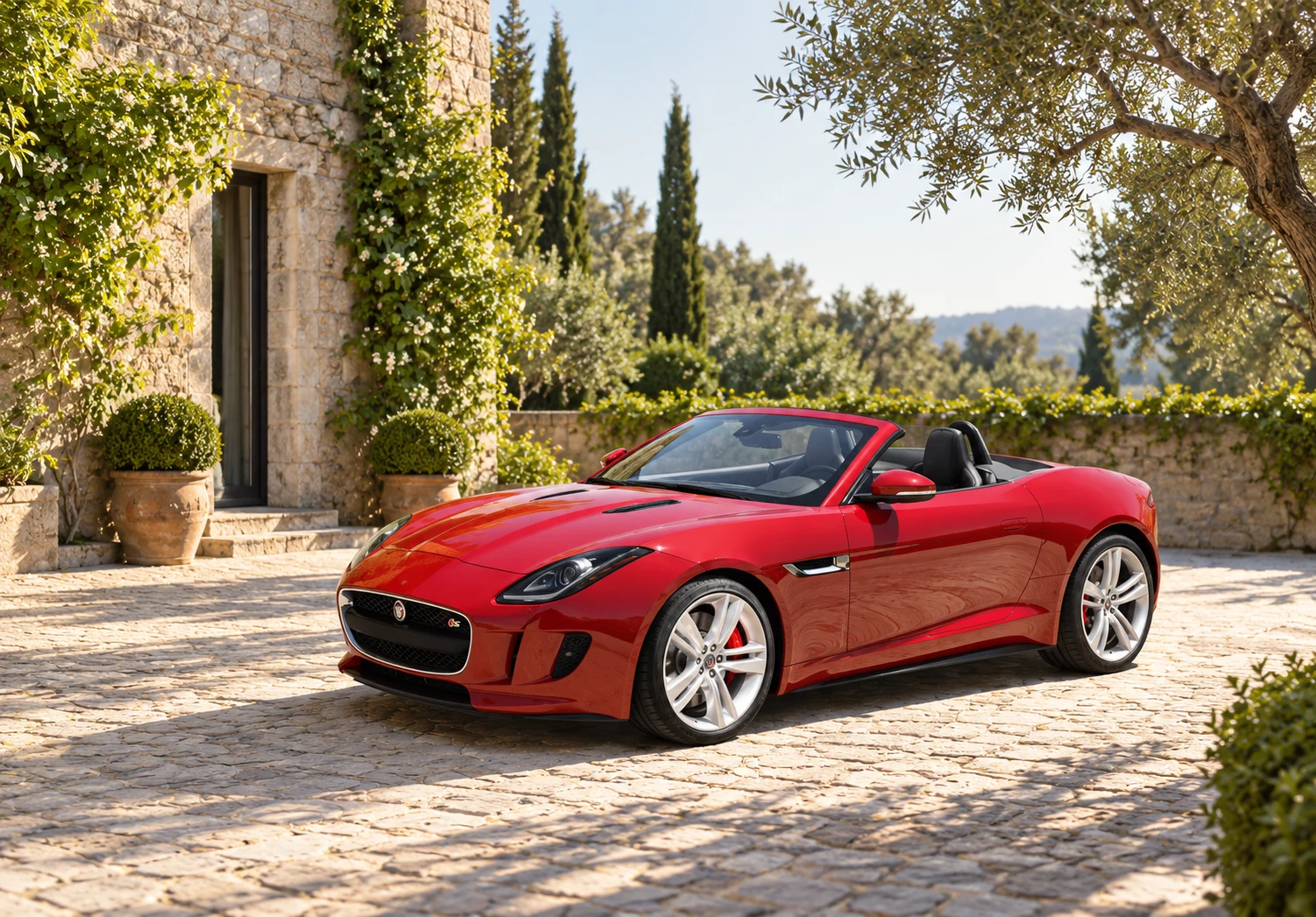
Jaguar confirmed the F-Type name and production programme at the New York motor show on 4 April 2012. The announcement described an aluminium two-seat convertible and the move into final road testing. The completed production design received its Paris reveal in September, with the launch release dated 26 September and the joint Jaguar Land Rover motor-show presentation following on 27 September.
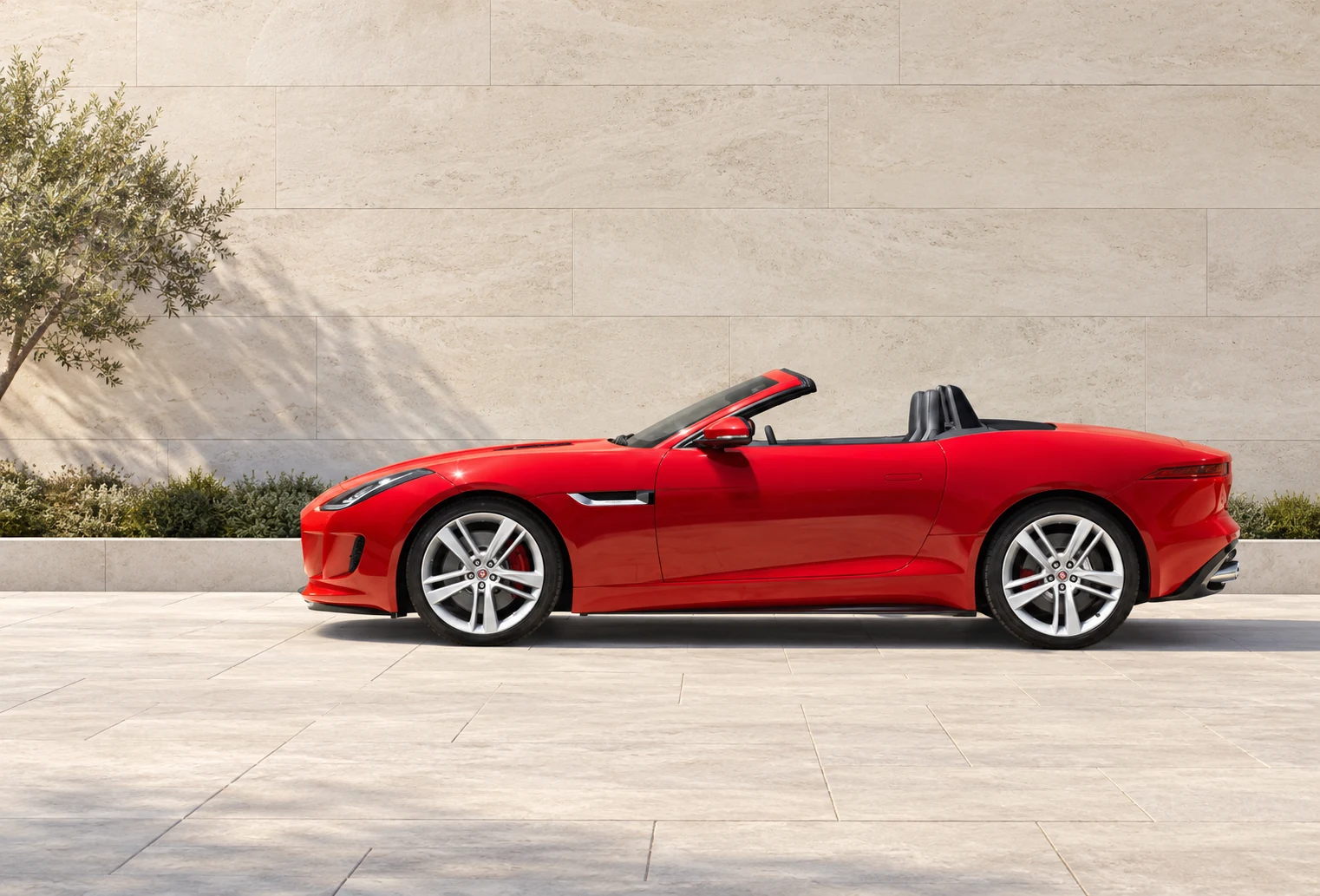
The original range comprised F-Type, F-Type S and F-Type V8 S. All were front-engined, rear-wheel-drive roadsters with supercharged petrol engines and an eight-speed automatic. Their differences included power, differentials, brakes, damping and exterior details. The story therefore reaches further than a list of acceleration figures.
This is the specification presented in 2012, with retail introduction still ahead in the launch plans. It does not combine the roadster with later coupés, four-cylinder engines or subsequent drivetrain revisions. The illustrations are reconstructions from period press imagery; performance figures below are the manufacturer’s published launch data.
At a glance
- Production programme confirmed in New York: 4 April 2012.
- Paris reveal release: 26 September; motor-show presentation: 27 September.
- Three supercharged launch variants: 340PS V6, 380PS V6 S and 495PS V8 S.
- Eight-speed Quickshift automatic, rear-wheel drive and a fabric roof.
- Mechanical limited-slip differential on V6 S; active electronic differential on V8 S.
- Deployable handles, rear spoiler and centre air vents helped keep the surfaces uncluttered.
From the April announcement to the Paris reveal
The April release followed the response to the earlier C-X16 concept. Jaguar committed to a new sports car called F-Type, explicitly describing a strict two-seater that would first appear as a convertible. Prototypes were entering final on-road testing from Castle Bromwich, where the production cars were planned to be built.
At that stage, the company had not published the complete production engine and equipment range. The September reveal supplied those details. Treating the April announcement as if every final specification was already available would collapse two distinct stages of development.
The earlier concept provided design context, while the production roadster had its own body, cabin and engineering specification. The first announcement also placed F-Type alongside the existing XF, XJ and XK families rather than presenting it as a new body style of one of those cars.
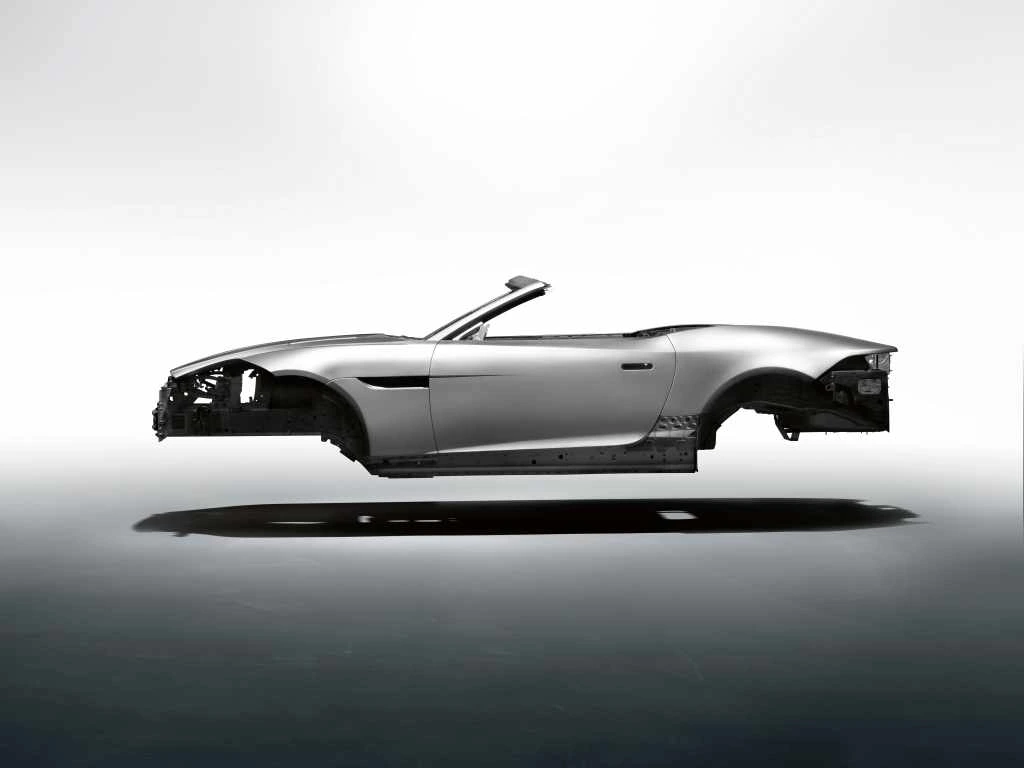
Aluminium construction supported a small, rigid platform
The body used Jaguar’s riveted and bonded aluminium architecture. Engineers developed structural and outer-panel alloys for different jobs: strength and controlled deformation in the structure, and greater formability for the shaped exterior panels. The one-piece clamshell bonnet was a prominent example of the latter.
The technical material quoted a 261kg core body-in-white and a complete-vehicle starting mass of 1,597kg. These are different measurements. The body figure did not describe a complete running car, and optional equipment or a different powertrain could change the final vehicle weight.
Jaguar also distinguished overall torsional rigidity from local stiffness. It described a 10% torsional increase relative to XKR-S and gains up to 30% in key local areas such as suspension mountings. Reporting the larger local number as a 30% improvement in every structural measure would overstate the result.
Packaging concentrated the mass within the wheelbase
The F-Type’s wheelbase measured 2,622mm, with published front and rear tracks of 1,585mm and 1,627mm. Shorter overhangs helped concentrate mass within that span. The driver’s position was described as 20mm lower than in XKR-S, contributing to the low sports-car layout.
Weight distribution work reached beyond the large mechanical assemblies. The battery and even the washer-fluid reservoir were placed in the rear compartment rather than the engine bay. A new aluminium front subframe reduced mass at the nose compared with a steel equivalent.
These decisions explain the engineering priorities: the body, occupant position and component placement were developed together. They were not simply a saloon powertrain installed beneath a shorter exterior.
Three launch engines, all with superchargers
The entry F-Type used a 3.0-litre V6 producing 340PS and 450Nm. F-Type S increased the V6 to 380PS and 460Nm. The V8 S used a 5.0-litre supercharged V8 at 495PS and 625Nm. The higher-output V6 was a particular F-Type application, rather than the 340PS tune described for the saloons.
Both V6 installations used direct injection, variable cam timing and a compact Roots-type twin-vortex supercharger in the V of the engine, with charge cooling. The engine family shared engineering principles with Jaguar’s V8 programme, while its packaging and balancing were developed for the six-cylinder application.
The V8 S output was deliberately specified for this car. It should not be replaced by the power figure of another Jaguar using a 5.0-litre engine. The same engine capacity or a similar badge does not establish identical calibration, cooling requirements or vehicle integration.
| Launch model | Engine | Power / torque | Published 0–100km/h | Published maximum |
|---|---|---|---|---|
| F-Type | 3.0 supercharged V6 | 340PS / 450Nm | 5.3 seconds | 260km/h |
| F-Type S | 3.0 supercharged V6 | 380PS / 460Nm | 4.9 seconds | 275km/h |
| F-Type V8 S | 5.0 supercharged V8 | 495PS / 625Nm | 4.3 seconds | 300km/h |
Quickshift was more than an eight-speed label
The eight-speed automatic was calibrated specifically for the sports car. Jaguar’s Quickshift approach used precisely timed engine-torque intervention during upshifts, together with drivetrain stiffness and control work, to create a sharper response. The launch material described a direct mechanical link through lock-up once the transmission had shifted into second gear.
An adaptive strategy selected between different operating programmes using acceleration, braking, throttle activity, cornering and road-load information. Corner Recognition could hold a gear through a bend, while the control strategy could retain a lower ratio between repeated overtaking demands. Downshifts were coordinated with engine-speed matching.
These are production control functions, not merely a published shift-time claim. Jaguar’s development work also examined how sound and movement influence the driver’s perception of a shift. We are describing that engineering programme, rather than reporting a gear-change feel from our own drive.
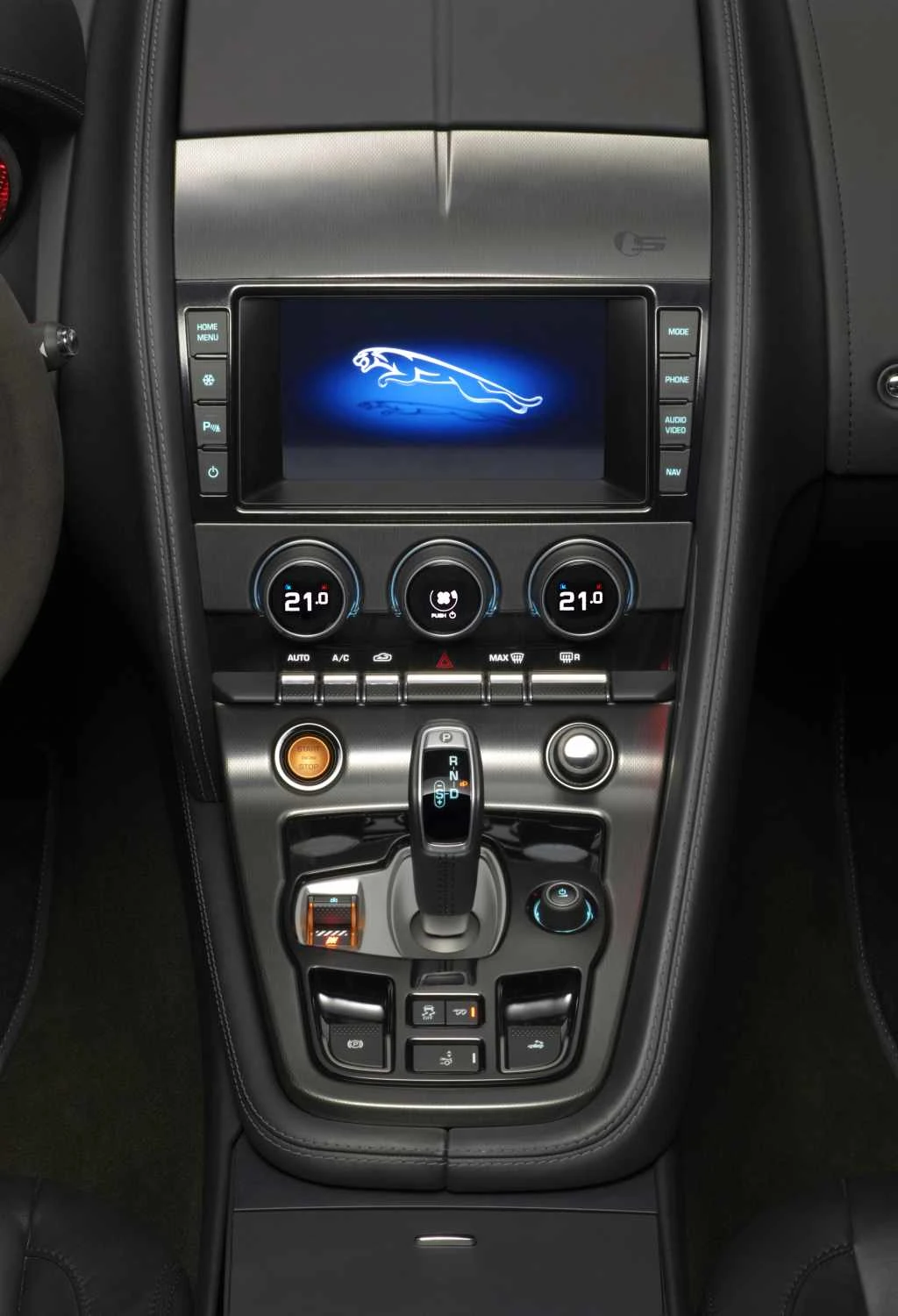
SportShift gave the driver a physical transmission control
The centre-console SportShift lever differed from the rotary selectors used in Jaguar saloons. Moving it into the manual gate allowed sequential control, with a forward push requesting a lower gear and a rearward pull an upshift. Steering-wheel paddles provided another manual interface.
With manual operation and Dynamic mode selected, the launch strategy did not automatically upshift at the redline, while retaining protective downshifting to avoid stalling. This was a defined combination of settings, rather than a claim about every operating mode.
F-Type S also had the launch programme’s Dynamic Launch function. Its availability belonged to that specific V6 S description. It should not be assigned to every model simply because the other cars also used Quickshift or had a Dynamic-mode control.
The two S models used different differential solutions
F-Type S received a mechanical limited-slip differential. The V8 S instead used an active electronic differential, with an electric motor acting on a multi-plate clutch to manage locking and traction. These were different hardware approaches matched to the respective powertrain.
The electronic differential worked with stability, traction and anti-lock braking systems. That coordination is a useful example of the car’s integrated control architecture: engine output, wheel grip and axle behaviour were not managed as isolated topics.
Neither arrangement turned the launch car into an all-wheel-drive model. The original roadster range presented here drove the rear wheels. The entry 340PS model should not automatically be credited with the limited-slip hardware specified for the S derivatives.
Suspension and steering were developed around the structure
Double-wishbone suspension at both ends used aluminium components. The rigid mounting structure, revised front subframe and front uprights were intended to give the suspension a more precise base from which to work. A quick-ratio steering rack was part of the same response-focused programme.
F-Type S and V8 S added Adaptive Dynamics, monitoring inputs and vehicle movement and adjusting damping rates up to 500 times a second. The system addressed vertical movement, pitch and roll through damper control. It was separate from the differential hardware and the transmission’s adaptive programmes.
Dynamic mode sharpened the coordinated responses and, on the adaptively damped cars, could add firmer body control. The launch descriptions are engineering intentions and operating functions, not an independent claim that one setting suits every road.
Configurable Dynamics separated the adjustable responses
The optional Configurable Dynamics system allowed elements of the Dynamic setup to be chosen individually. The driver could, for example, combine sharper throttle response and heavier steering with the normal ride setting. That was more flexible than treating one mode button as an inseparable bundle.
The option also added touchscreen functions intended for track use, including lap and split timing, throttle and brake information and a G-force display. These functions belonged to the specified equipment package. A touchscreen alone did not confirm their presence.
The distinction is relevant when identifying a car or a replacement control unit. A switch, display graphic and actual configured capability are related but separate pieces of evidence; the original build specification provides the context.
Brake specifications increased across the range
The 340PS F-Type used 354mm front and 325mm rear discs in the launch specification. F-Type S increased the front discs to 380mm. V8 S combined 380mm front discs with 376mm rear discs. Caliper colours and the system names varied with specification.
The cooling programme used the front openings and shaped underbody/suspension airflow to direct air towards the brakes. ABS, electronic brake-force distribution and emergency brake assistance were standard functions described across the range.
These figures identify the original production combinations. They should not be confused with a later optional system or used to order parts without confirming the actual vehicle, especially where a previous owner may have changed components.
Active exhaust was standard on the S derivatives
The V6 S and V8 S had an Active Exhaust system as standard, while the 340PS car could be specified with it as an option. Electrically controlled bypass valves in the rear exhaust changed the gas route under relevant operating conditions, altering the sound.
The system was integrated with the driving modes, with an additional override control available according to specification. Jaguar also developed an intake-feedback arrangement and cabin acoustic tuning to let occupants hear more of the engine’s operation.
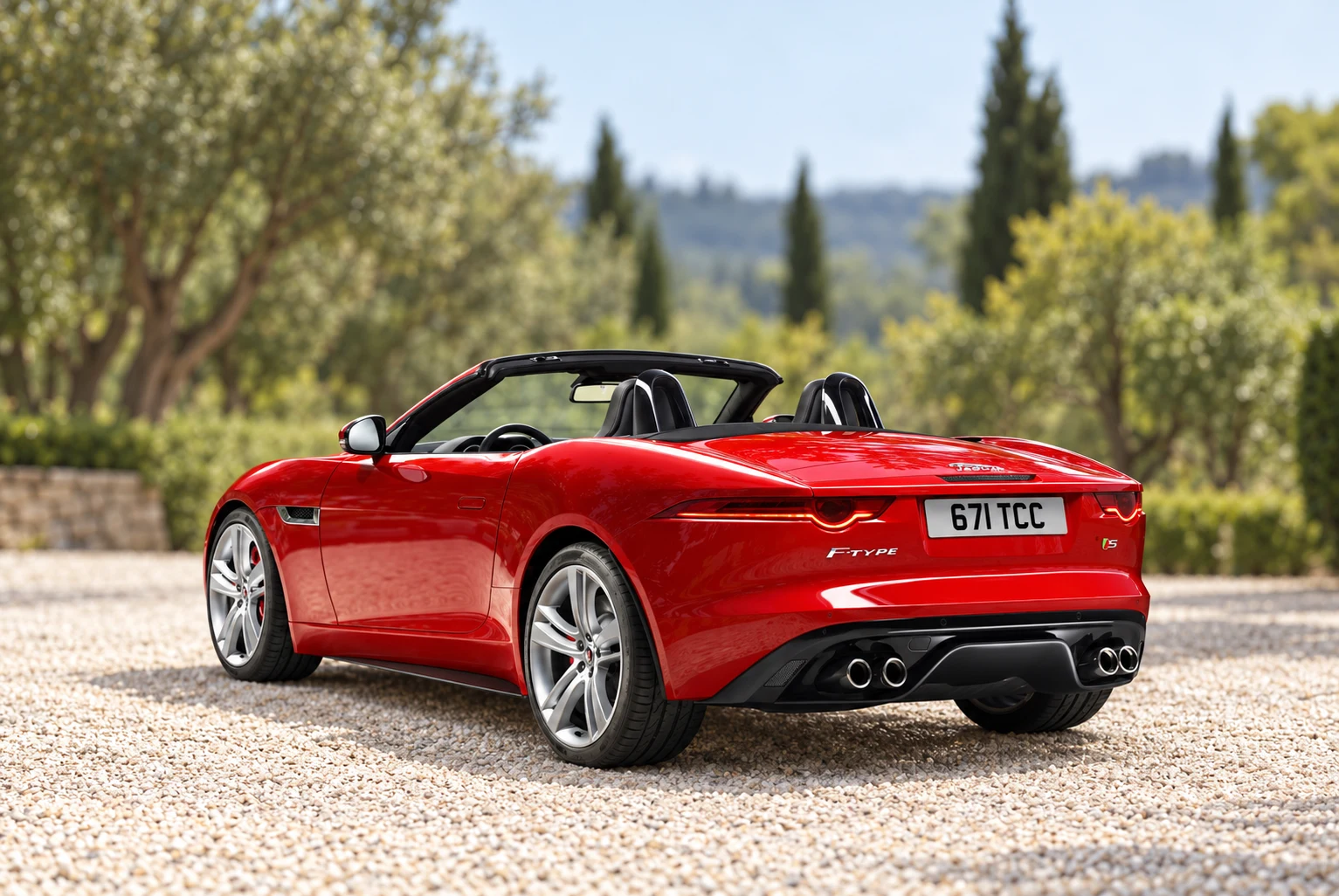
The exhaust finishers helped distinguish the engines visually. The V6 used twin central outlets, while the V8 S had four outboard outlets and a corresponding rear valance. These details matter when selecting an illustration: a V8 S rear should not be presented as the exact standard rear of the entry V6.
Deployable handles were an access interface and a design choice
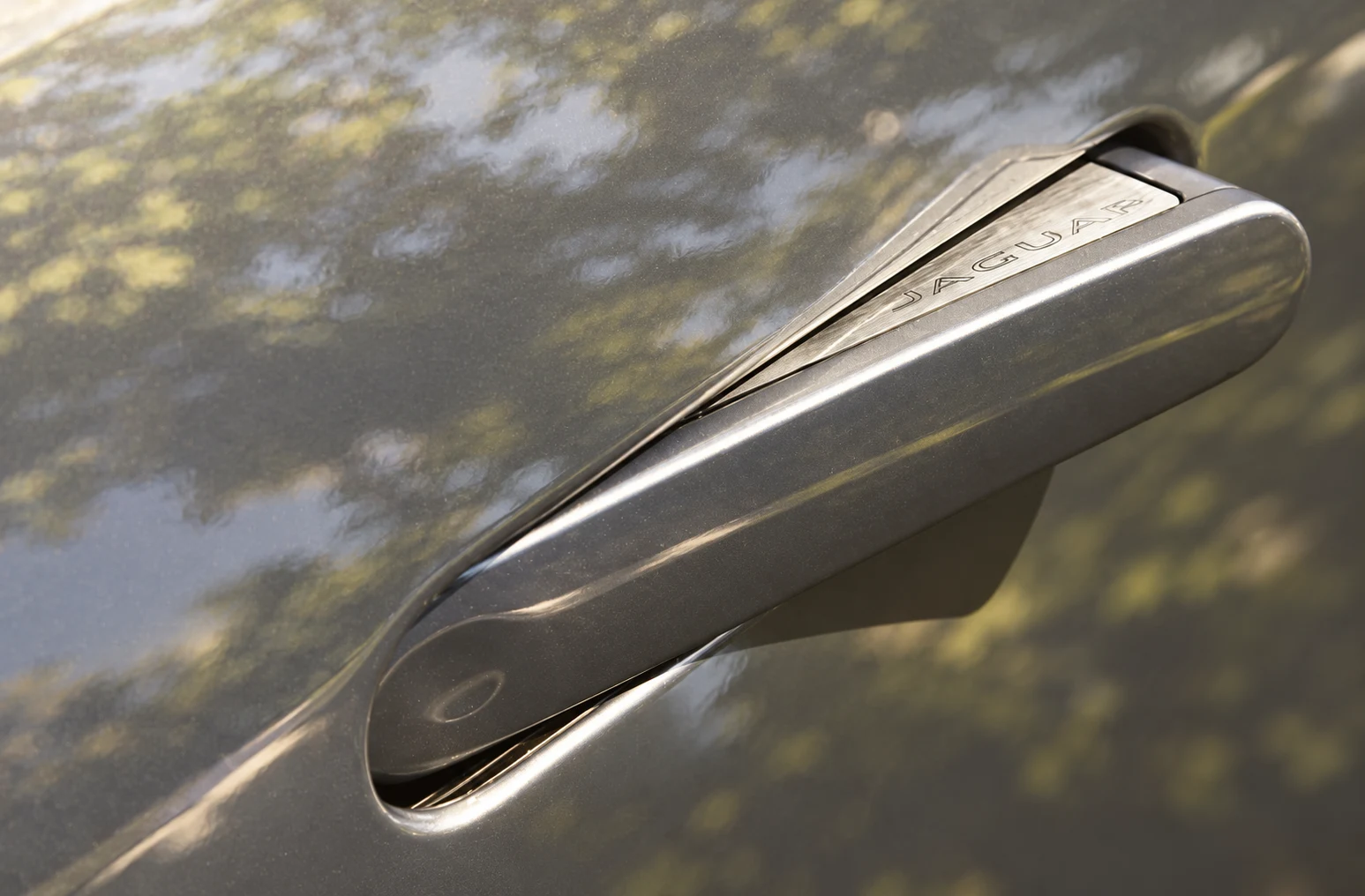
The door handles sat flush when not in use. The launch material described deployment after unlocking with the key fob or activation of the touch-sensitive handle area, with retraction once the car was moving. The mechanism helped keep the door surface visually clean.
The visible handle movement should be distinguished from the authorisation behind access and engine starting. A handle that does not deploy, a remote command that is not received and a car that does not recognise a starting key are different observations. The historical design does not identify the cause of a present fault.
For an access enquiry, record which functions work with each existing key and whether the symptom affects one door or more. Our Smart Key diagnostics page provides the relevant service context without assuming that every handle or starting complaint requires the same remedy.
A moving spoiler kept the stationary shape uncluttered
The rear spoiler was hidden in the body when not required. The launch technical description gave deployment at 60mph and retraction below 40mph. Its purpose was to balance the aerodynamic behaviour while preserving the low, clean rear shape at rest.
The front splitter and shaped rear valance contributed to the broader aerodynamic package. V8 S also had additional front and sill elements for its higher-speed specification. The spoiler therefore belonged to a vehicle-level airflow programme, rather than being an isolated decorative device.
The slim rear lamps used LED technology, while the original front units combined bi-xenon lighting with J-Blade LED daytime running lights. Describing the car simply as having modern full-LED headlamps would lose that period-specific distinction.
The roof was fabric, with a defined operating envelope
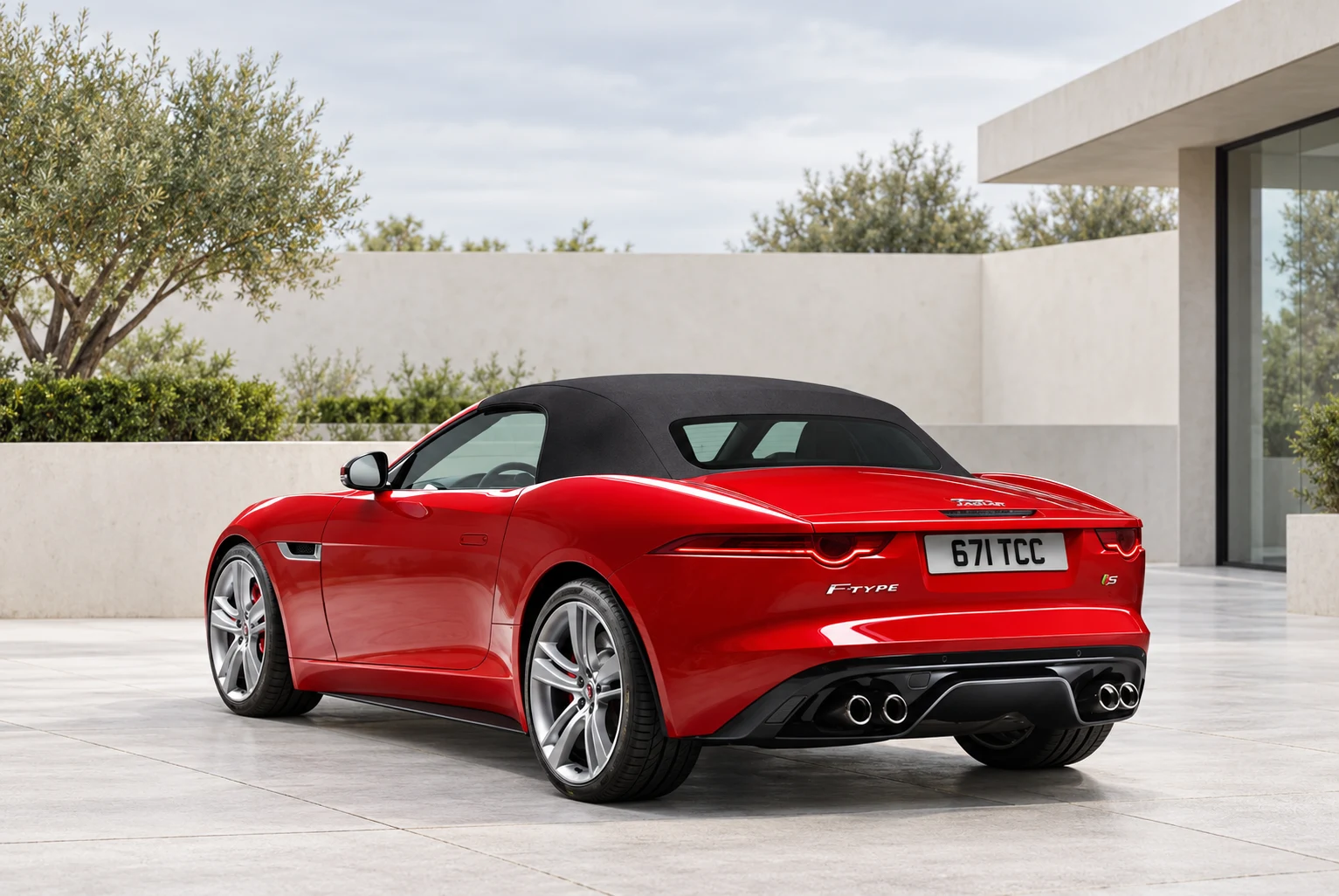
Jaguar chose a fabric convertible roof to reduce mass, improve packaging and keep the centre of gravity low. The multi-layer construction included an insulating lining for thermal and acoustic performance. The launch claim was a complete raising or lowering cycle in 12 seconds at speeds up to 30mph.
The car remained a two-seat roadster with the roof raised. The fabric roof, rear window and deck arrangement are part of its original body identity; a later fixed-roof F-Type is not a substitute illustration of the same launch specification.
Those operating figures describe the new system as presented. They do not establish the condition of an old roof mechanism or explain every interruption in its operation. The historical interest is how the roof choice supported the compact sports-car package.
The cabin used a deliberate one-plus-one layout
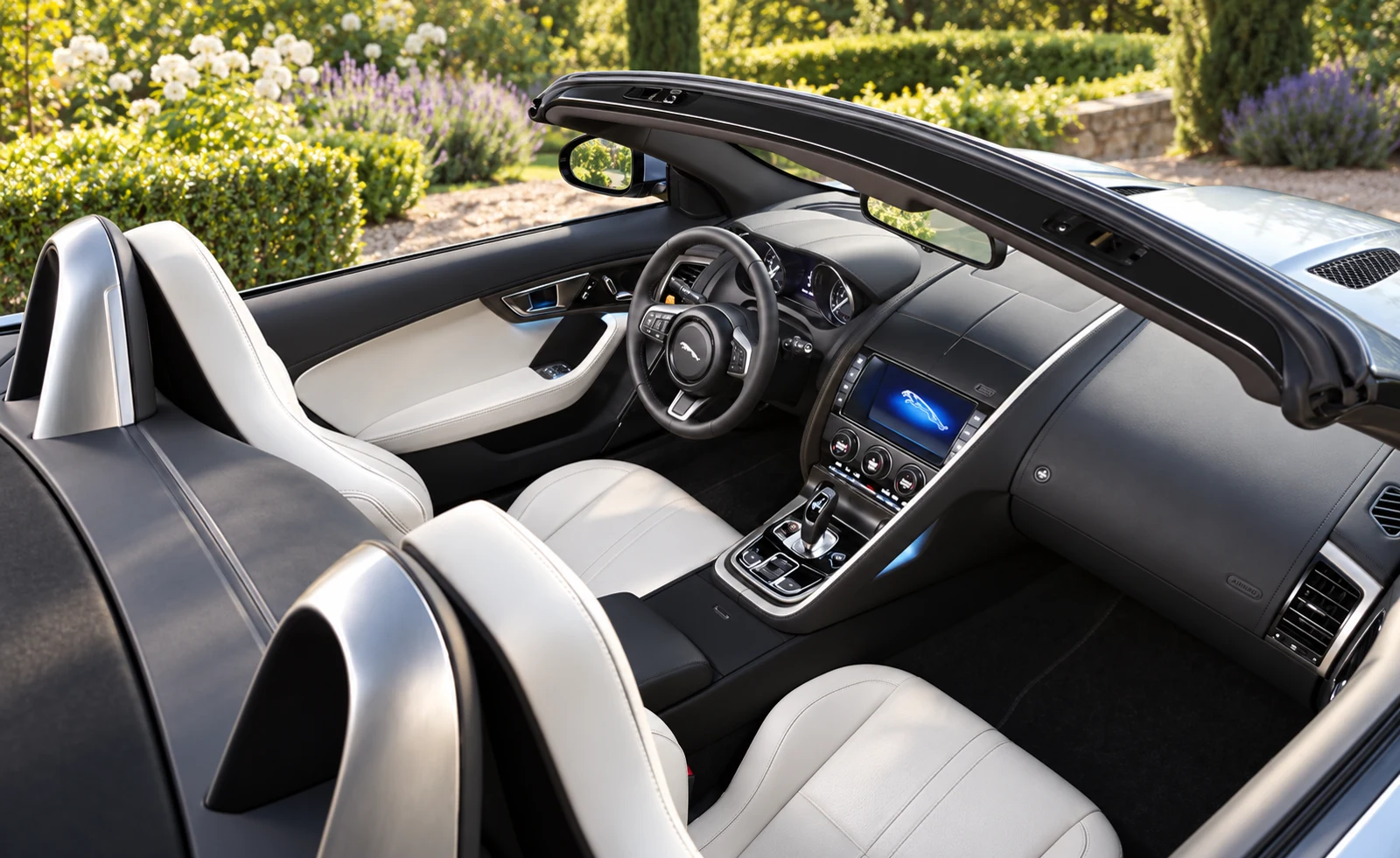
A sweeping grab handle on the passenger side divided the centre console from the driver’s controls. Different surface treatments reinforced the asymmetry, while the engine-start button, paddles and Dynamic control on the S models used the Ignis accent colour described in the technical material.
Analogue main instruments framed a central TFT information screen. Physical climate dials sat below the central touchscreen; where heated seats were fitted, the outer dials could take on seat-temperature control. This was an interface designed around regular touchpoints rather than transferring every action onto one display.
Seat specifications also varied. The standard arrangement combined electric height/recline adjustment with manual fore-and-aft movement, while more extensively adjustable and more supportive seat options were available. A highly equipped press car should not be treated as the sole standard cabin.
Rising centre vents responded to climate demand
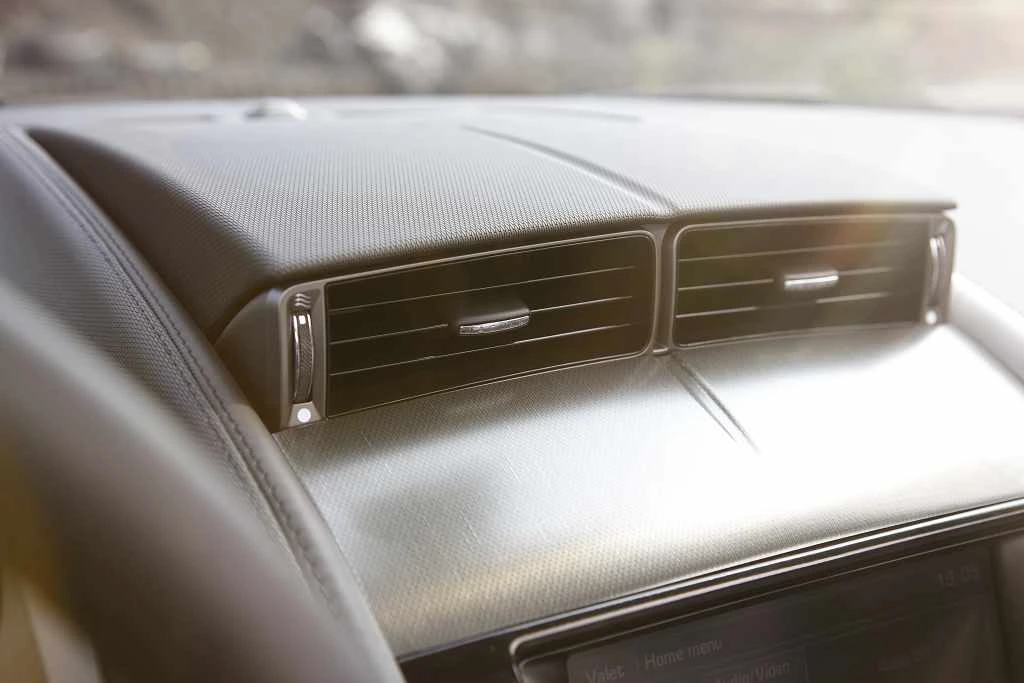
The centre vents could remain hidden until the climate-control strategy required them, then rise from the top of the dashboard. The launch explanation described algorithms governing their use as well as the driver’s requirements. Their position was therefore part of intended system operation.
It would be inaccurate to assume that a vent staying retracted in one moment always indicates a broken motor. Equally, the feature’s existence cannot diagnose an actual climate-control complaint. The important historical point is the integration of a moving trim element with the ventilation strategy.
Meridian provided two of the car’s three audio levels: 380W with ten speakers and 770W with twelve. The higher system used Trifield processing. These were F-Type-specific installations, not the 825W configurations described for the contemporary Jaguar saloons.
Stop/Start and the wider electronics package
Intelligent Stop/Start was included across the launch engine range. Its twin-solenoid starter strategy allowed the engine to restart even during the running-down phase if the driver changed intention before it had fully stopped. The system’s operation depended on its control conditions, rather than being an unconditional shutdown at every halt.
The car combined this starting strategy with transmission, engine, differential, damping and climate control. Several systems could influence what the driver felt or saw, which makes a precise symptom description more useful than one broad complaint about “electronics”.
For a replacement-module enquiry, retain the original identification before buying another unit. Our module-information guide explains what to record. The launch technology story provides context but does not establish that a particular donor unit or software file is compatible.
What the original reveal established
By September 2012, the production roadster’s identity was clear: an aluminium two-seater, rear-wheel drive, a fabric roof, supercharged engines and a carefully coordinated set of controls. The model differences were concrete, extending from output and brake dimensions to differential type and damping.
The April announcement and September reveal belong to one development story, so they are brought together here rather than turned into near-duplicate articles. Keeping the original specification intact also makes later model changes easier to recognise when the archive reaches those years.
December: development cars on road and track
On 13 December 2012 Jaguar described a drive of camouflaged F-TYPE S and V8 S prototypes at Snetterton and on Norfolk roads by invited racing drivers. The 380PS V6 and 495PS V8 cars were said to represent intended production dynamics and powertrains. This was a manufacturer-organised development presentation, not this journal’s independent road test or the start of customer deliveries.
Illustrations recomposed from period press imagery. Image licence.